Read attentively. Ask difficult questions. Listen to another voice. Practise responsible ministry. Return to the text with a deeper understanding.
weekly learning units
16
planned teaching hours
40
total planned learning hours
120
preparation + exam hours
7 + 3
M.Div. source-linked pilot · Supplied reader mapped · Faculty release remains required · Credits are not assigned by this template.
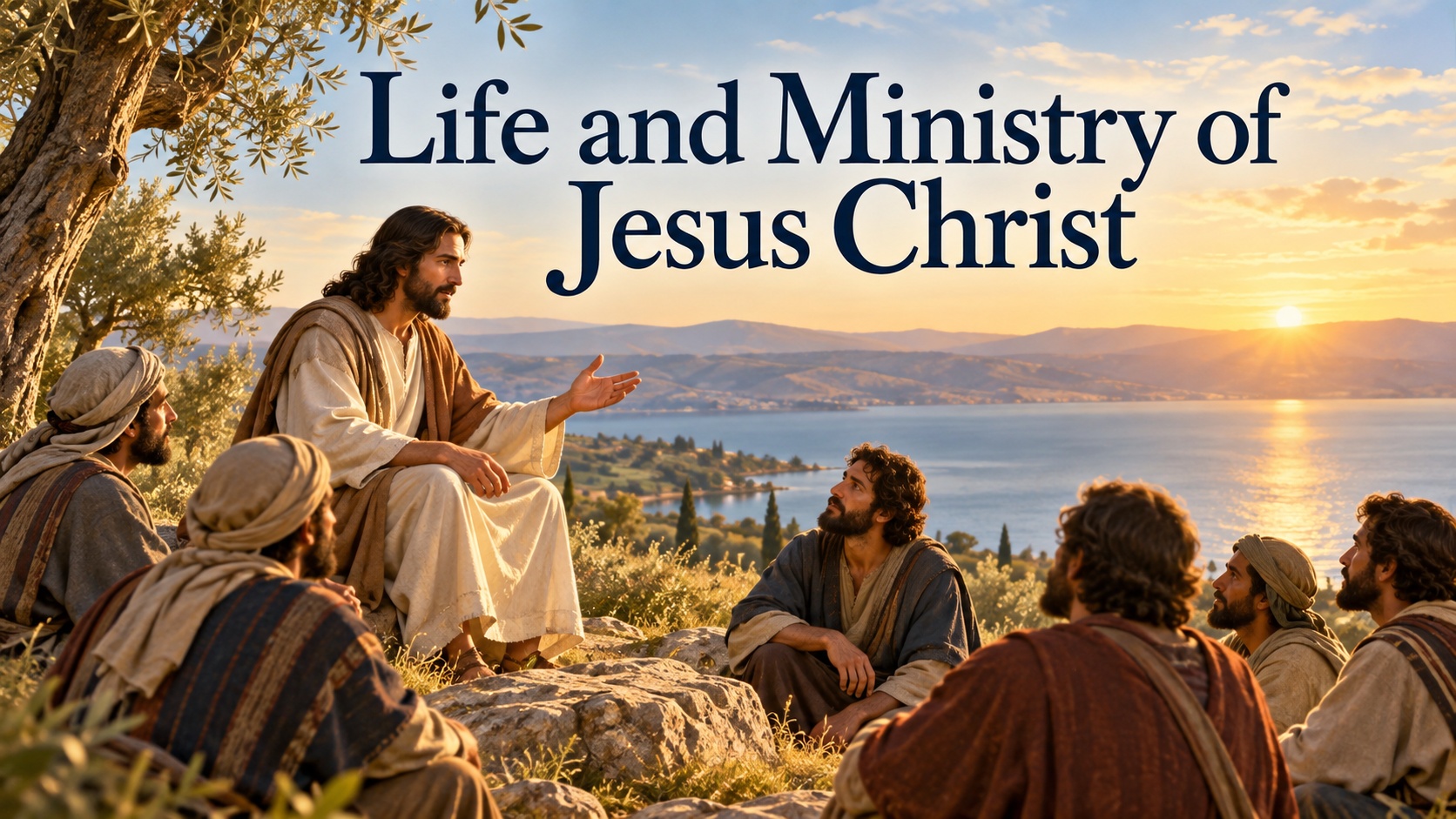
Course illustration supplied with the reader—not a historical photograph.Start here: purpose, outcomes and safe participation
The course explores the four Gospels, their contexts and distinct voices, Jesus’ words and works, discipleship, servant leadership, passion and resurrection. These original learning activities supplement the supplied Word syllabus; they do not silently revise it.
O1 · Distinguish Gospel testimony, historical questions, interpretation and contemporary application; explain the limits of a claim.
O2 · Compare Gospel passages attentively, respecting each narrative rather than forcing a single chronology.
O3 · Interpret Jesus’ teaching, kingdom proclamation and works with textual and contextual evidence.
O4 · Evaluate discipleship, inclusion and servant leadership through responsible, locally relevant ministry cases.
O5 · Explain how the passion, resurrection and commissioning shape the Gospel accounts of Jesus’ ministry.
O6 · Create, receive feedback on and revise an evidence-based ministry response, acknowledging assumptions and limitations.
How each week works
Anchor a question → add textual and reader evidence → apply through a fictional case or creative task → take away a reasoned next step. Prepare an observation, invite a peer’s question in the scheduled class, and revise your interpretation. Discussion preparation below is private: there is no public posting or forum submission.
Use fictional cases. Do not enter counselling, health or private family records. Personal testimony is optional, not a condition of learning or a spiritual-maturity score. Avoid collective blame, coercion and unsupported promises of healing. Ask faculty about accessible text/audio alternatives, accommodations and a safe way to raise concerns.
Use your own or a lawfully available Bible edition for the references. Cite the edition and approved reader in formal work. The supplied chapter and section readings are mapped below. Follow faculty instructions for dates, formal assessments and accommodations. Class and library links remain in the main course portal.
Workload, assessment and feedback guide
Teaching is included in the 120 planned hours. These allocations are not automatic evidence of study. Teaching-hour convention: See the current setting in your assigned room. Record active learning minutes separately from breaks.
Proposed 16-week learning budget
Week
Teaching
Reading
Writing
Formative practice
Independent preparation
Final exam
Total
1
2.5
2
2
1
0
0
7.5
2
2.5
2
2
1
0
0
7.5
3
2.5
2
2
1
0
0
7.5
4
2.5
2
2
1
0
0
7.5
5
2.5
2
2
1
0
0
7.5
6
2.5
2
2
1
0
0
7.5
7
2.5
2
2
1
0
0
7.5
8
2.5
2
2
1
0
0
7.5
9
2.5
2
2
1
0
0
7.5
10
2.5
2
2
1
0
0
7.5
11
2.5
2
2
0
1
0
7.5
12
2.5
2
2
0
1
0
7.5
13
2.5
2
2
0
1
0
7.5
14
2.5
2
2
0
1
0
7.5
15
2.5
2
2
0
1
0
7.5
16
2.5
0
0
0
2
3
7.5
Hours
40
30
30
10
7
3
120
Weeks one to ten use the ten allocated practice hours for three-question reader quizzes, retrieval, evidence and feedback. Weeks eleven to sixteen place their retrieval checks inside the existing preparation hours, not an added quiz allocation. Worksheets share the writing budget; no new grade component is introduced.
Preserved source evaluation
Class participation5%
Prepared textual observations, constructive listening and contributions in the faculty-led class. A page visit is not attendance.
Reading report20%
A report on the approved reader, distinguishing an author’s argument, textual evidence, a critical question and a ministry implication. Reader chapter sections are mapped; the formal report length and marking arrangements require faculty approval.
Main term paper / assignment15%
The source assignment: relevance of Jesus’ Sermon on the Mount in today’s context. Develop a focused argument, consider a competing reading and revise a contextual application.
Final examination60%
A comprehensive faculty-set examination. The approved workload block is seven hours of independent preparation plus a three-hour exam; the pilot does not administer or grade that exam.
The source also requires class presentations and two reflection papers of 3–5 pages. Faculty must confirm how these sit inside the source assessment components; this pilot adds no extra percentage, mandatory word count or formal deadline. The term paper, two reflection papers and reading report share the 30-hour writing budget.
Formative review rubric · no automatic marks
Text and evidence
Developing
Retells a passage or makes a claim with little support.
Proficient
Uses relevant passages and traceable reader citations to support an interpretation.
Extending
Weighs evidence and alternative readings; states what the evidence cannot establish.
Context and comparison
Developing
Assumes all Gospel accounts or modern settings are interchangeable.
Proficient
Recognises narrative differences and explains relevant ancient and local contexts.
Extending
Evaluates a contextual comparison without flattening differences or stereotyping communities.
Reflective judgement
Developing
Offers an opinion without examining its assumptions.
Proficient
Identifies an assumption, a question and a reasoned revision.
Extending
Responds thoughtfully to counter-evidence or peer feedback and explains how judgement changed.
Responsible ministry and communication
Developing
Proposes an action without considering people, risks or sources.
Proficient
Communicates a feasible, respectful application with citations and clear boundaries.
Extending
Includes consent, safeguarding, accountability and a realistic way to review the action.
Suggested final-exam blueprint for faculty review
Cover source/context and method (O1), comparative passage interpretation (O2–O3), ministry/discipleship judgement (O4–O6), and passion/resurrection synthesis (O5). Practise outlining an evidence-based comparison and a responsible ministry response. Faculty sets the actual paper, section marks, permitted materials, pass rules, accommodations, feedback and appeals. No summative answer key or exam delivery is published here.
Your sixteen-week journey
0 of 16 weeks self-marked studied
Ordinal weeks repeat with each offering. There are no invented calendar dates, automatic attendance claims or credit awards.
Week 1 · Listen and question
Encountering Jesus through the Gospels
Outcomes: O1 · O2
Source coverage: The importance of the study of the life of Christ; The quest of the historical Jesus; Sources and chronology
Teaching:
2.5 h
Reading:
2 h
Writing:
2 h
Formative practice:
1 h
Anchor
Begin with a question
Name one picture of Jesus you bring to this course. What shaped it, and what question might challenge it? You may use a fictional learner instead of personal disclosure.
Read and investigate
Reader supplied and aligned. Use these chapter/section headings, not an assumed page number. The two-hour reading allocation includes the designated reader sections, Gospel comparison and source checking.
Luke 1:1–4
John 20:30–31
Mark 1:1–15
Hebrews 1:1–4
John 1:1–18
Philippians 2:5–11
Chapter 1 · The Importance of the Study of the Life of Christ
Establish the reader's Christ-centred, chronological and ministry-focused approach.
§1.1 · Jesus Christ as the Center and Fulfillment of Divine Revelation
§1.2 · The Incarnation: Beholding God in Human Flesh
§1.3 · Meeting the "Real" Jesus of the Gospel Record
§1.4 · The Devotional and Ministerial Value of This Study
§1.5 · Distinguishing This Course's Focus from the Synoptic Gospels Course
Full reading text is a protected course-room resource, not included in this public preview. Ask faculty if it is not yet among your released materials.
Worksheet integration: Worksheet 1: short answers 1–4; choose one reflection/application prompt. A fictional ministry context is acceptable.
Worksheets support the existing writing and preparation budgets. These instructions do not submit a worksheet, add a deadline or create a new grade component. Personal disclosure is optional; fictional examples are welcome.
Reader-guided teaching notes and interpretive questions
Chapter 1 connects the study of Jesus with revelation, incarnation and ministry formation. Within the reader’s confessional approach, Hebrews 1:1–4 and John 1:1–18 are theological starting points: the course asks who Jesus is as well as what he did. Explain a theological claim with its passage rather than assuming that a devotional impression alone establishes its meaning.
The chapter holds together genuine humanity and deity and introduces the language of Chalcedon. Practise explaining why both matter to reading prayer, weariness, compassion and authority in the Gospels. Philippians 2:5–11 connects Christology with service, but the move from doctrine to a present-day action still needs careful reasoning and respect for human limits.
Section 1.5 distinguishes this course’s whole-life, harmonised approach from the companion Synoptic Gospels course. Use a broad chronological scaffold while retaining each Gospel’s identifiable contribution. Keep a learning log with a passage, an interpretation, an application and an unanswered question. Growth is not measured by how much private experience you disclose.
Begin with the way each passage introduces its purpose. Luke describes an account addressed to a reader; John identifies a purpose for selected signs. Ask what each introduction invites its audience to notice. A Gospel is not simply a list of events to memorise: its arrangement, emphasis and invitation to respond matter to interpretation.
Keep four columns in your notes: what the text says, a historical question, an interpretation and a possible application. These are related but not identical. A modern experience can generate a valuable question without proving an ancient meaning. The historical-Jesus quest belongs in this methodological conversation; use the supplied reader to examine its approaches rather than assuming a single uncontested reconstruction.
Faculty facilitation guide
Frame the week’s outcomes and invite the anchor question. Teach the selected passages with the approved reader; surface a plausible competing reading. Facilitate the case and peer conversation, invite evidence-based feedback, and close by identifying a revision or next step. Provide text notes for low-bandwidth access. Allocate the 2.5 teaching hours under the approved hour convention; these notes do not claim to be 2.5 hours of delivered instruction.
Apply · Case laboratory
Think with a fictional situation
A study leader says, ‘My experience settles what this passage means, so we need no further questions.’ How would you keep the conversation welcoming and evidence-based?
Build a two-column learning covenant: evidence-based understanding and accountable practice. Add a short devotional outline from Chapter 1, clearly labelling passage, interpretation and application; include one question you will revisit in week sixteen.
Evidence to prepare: A comparison map and one question to bring to class; participation is reviewed by faculty, not by this checklist.
Writing/preparation plan: Start a reading log and a baseline reflection. These are parts of this week’s writing allocation, not extra hours.
Reader sources and adaptation notes
The supplied syllabus describes ten sessions and an approximate 100–110-page reader. The LMS adapts the ten chapters to sixteen weeks. Page counts are not independently verified; assignments use chapter/section headings instead.
Both appendix Word files have identical extracted body and footnote text. One learning copy is used; both unchanged originals remain in the private archive.
Some chapters repeat closing paragraphs. Repeated transitions are not separate learning outcomes or additional compulsory work. Original files are not silently edited.
The supplied source diagram contains misleading arrows and treats hypothetical sources too certainly. The portal’s original diagram labels the model and its uncertainty, with no Q-to-Mark arrow and no settled Gospel-date claims.
Bibliographic editions/page citations and sweeping historical or religious descriptions require faculty checking. Original source language is preserved privately, not automatically adopted as the portal’s teaching voice.
The reader syllabus adds worksheets and its final chapter proposes a short capstone reflection. Faculty must integrate these with the earlier 5/20/15/60 evaluation and two reflection papers without adding unexplained marks or hours.
Planned work and your own record are different
You have self-marked 0 weeks and recorded 0 actual minutes. These are your own reports, not verified achievements. Faculty review, formal assessment, attendance correction and official credit awards remain separate processes.
Take the course guide offline
Download all sixteen weeks of original study notes, tasks and formative guidance as a lightweight text file. The reader and private student notes are not included.